
 Facebook
 X
X
 Pinterest
 Copy Link
Beautiful Houses, Big Trees & a Few Things to Watch
If you’ve spent an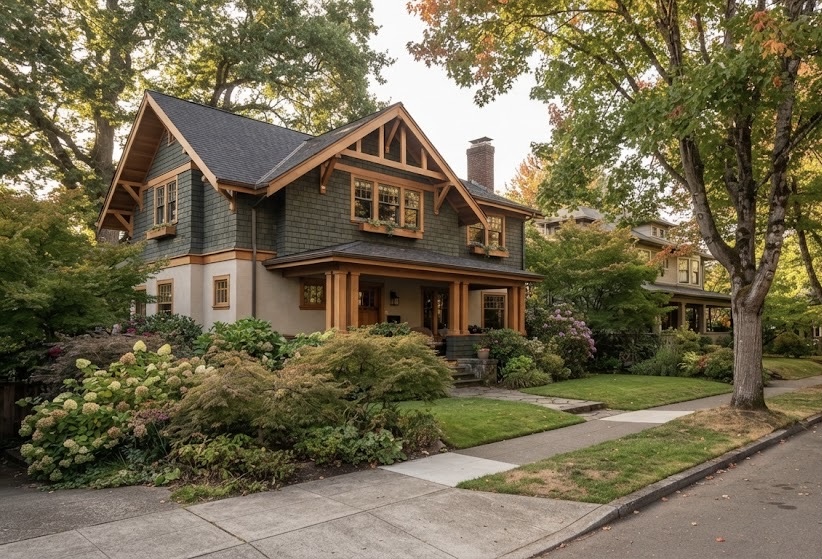 y time looking at old houses in Northeast Portland, you’ve probably figured out that Alameda is pretty easy to fall for.
I mean, look around.
Craftsman bungalows. Tudor-style houses. English Cottages. Colonial Revivals. Big old houses sitting up on the hill. Front porches. Mature trees. Interesting little streets.
And, depending on where you are, some pretty great views.
What’s not to like?
Well…
You’re buying an old house.
So there are a few things.
I’ve spent a lot of time looking at houses throughout Northeast Portland, and Alameda is one of those neighborhoods where I think buyers need to look beyond the pretty stuff.
Because the pretty stuff is usually what gets you.
You walk in.
You see the original woodwork.
The fireplace.
The built-ins.
The old-growth floors.
And five minutes later you’re mentally arranging your furniture.
That’s when I start looking at the basement.
First, Let’s Talk About the Hill
Alameda sits along the Alameda Ridge, which is a big part of what makes the neighborhood interesting.
It also means that some houses are sitting on some pretty serious slopes.
And that can be great.
You might get a view.
You might get a dramatic front porch.
You might get a backyard that feels like you’ve got your own little piece of Portland.
You might also get:
Stairs.
Lots of stairs.
And with an older house on a slope, I want to pay attention to things like drainage, retaining walls, foundations, driveways and how water moves around the property.
Because a great view is wonderful.
Water in the basement?
Not so much.
The Houses Are the Fun Part
One of my favorite things about Alameda is that the houses don’t all look alike.
And that’s a good thing.
You can find a beautifully preserved Craftsman with original built-ins and woodwork, then walk a few blocks and find a completely different architectural style.
Some houses have been lovingly restored.
Some have been thoroughly remodeled.
Some have been remodeled so many times that you’re not entirely sure what decade you’re in.
And some are just waiting for somebody to figure out what to do with them.
That’s where I think buying an old house gets interesting.
You’re not just asking:
“Do I like this house?”
You’re asking:
“What is this house telling me?”
Now Let’s Go Downstairs
Ah, the basement.
Every old Portland house has a story down there.
Maybe it’s a great finished family room.
Maybe it’s a workshop.
Maybe it’s storage.
Maybe there’s a bathroom that looks like it hasn’t changed since 1974.
Or maybe there’s a bedroom down there that appears on the listing as a “fourth bedroom,” but nobody has actually checked whether it’s legal living space.
This is where you want to slow down.
If an attic or basement has been converted into living space, I’d want to know what permits were pulled and what the City records actually show.
Because there’s a difference between:
“There’s a bedroom downstairs.”
and
“There’s a permitted bedroom downstairs.”
Those are not necessarily the same sentence.
And Then There Are the Trees
I love the trees in Alameda.
They are one of the reasons the neighborhood feels like Alameda.
But trees and old houses have a relationship that’s sometimes… complicated.
Leaves in the gutters.
Branches over the roof.
Roots.
Maintenance.
And the occasional moment when you realize that the enormous beautiful tree in the backyard is approximately three feet from the foundation.
Again, I’m not saying don’t buy the house.
I’m saying look up, look down and look around.
What About Remodeling?
Here’s an important distinction between Alameda and Irvington.
Don’t assume that because a house is old—and because it’s in one of Portland’s classic historic neighborhoods—that it automatically has the same historic rules as an Irvington property.
It doesn’t work that way.
The individual property matters.
So if you’re thinking about buying an Alameda house because you’re already picturing a big addition, new windows, a second-floor remodel or some other ambitious project, let’s do a little homework first.
What’s the property’s historic status?
Is it in a designated district?
Is it listed in the City’s Historic Resource Inventory?
What has already been changed?
What was permitted?
And what exactly are you hoping to do?
Figure that out before you buy the house.
Not after you’ve already bought the cabinets.
My Old-House Checklist
When I’m looking at an older Alameda house with a buyer, I’m thinking about a lot more than whether the kitchen looks good.
I’d want to look at:
The foundation.
Especially on a sloping lot.
Drainage.
Where does the water go when it rains?
The basement.
Dry? Damp? Finished? Permitted?
The roof and gutters.
Because old houses and water are not always best friends.
The windows.
Original? Replaced? Repairable?
Electrical and plumbing.
What’s old? What’s new? What’s been done?
The permit history.
Especially for additions and finished basement or attic spaces.
The historic status.
Don’t assume. Check the individual property.
But Don’t Forget to Have Some Fun
This is probably the most important part.
Yes, I’m going to tell you to check the foundation.
Yes, I’m going to tell you to look at the sewer.
Yes, I’m going to ask about permits.
That’s my job.
But I also want buyers to appreciate why they’re looking at an old house in the first place.
The built-ins.
The old tile.
The staircases.
The woodwork.
The windows.
The weird little rooms.
The front porch.
The craftsmanship.
The fact that somebody built this house 80, 90 or 100-plus years ago and thought carefully about how it should look and feel.
This is where my design background probably shows.
I’m always looking for the stuff that makes the house the house.
And sometimes the best thing you can do is restore it.
Sometimes it’s remodel it.
And sometimes…
Don’t mess with the good stuff.
One Last Thing
Don’t buy an old Alameda house because you think you can turn it into a brand-new house.
That’s usually an expensive way to discover that you actually wanted a new house.
Instead, figure out what you love about the old house.
Figure out what’s going to need work.
Figure out what you can change.
And then decide if the combination makes sense for you.
Because here’s my rule:
Don’t buy the house you think you can turn it into. Buy the house you actually want to own.
The goal isn’t to find an old house with no problems.
Good luck with that.
The goal is to find the house whose problems you can live with—and whose good stuff makes you smile every time you walk through the front door.
And Alameda has a lot of good stuff.
Next up: The Portland Old House Guide, Part 4 — Laurelhurst: More Than a Pretty Neighborhood
Richard Glass has lived in Portland’s Irvington neighborhood since 2004 and is a Portland real estate broker with Windermere Realty Trust, also known as ThePortlandBroker. I work with buyers looking at older and historic homes throughout Portland.
Buy the house you love—but understand what you’re buying.
